The timing could hardly be more interesting.
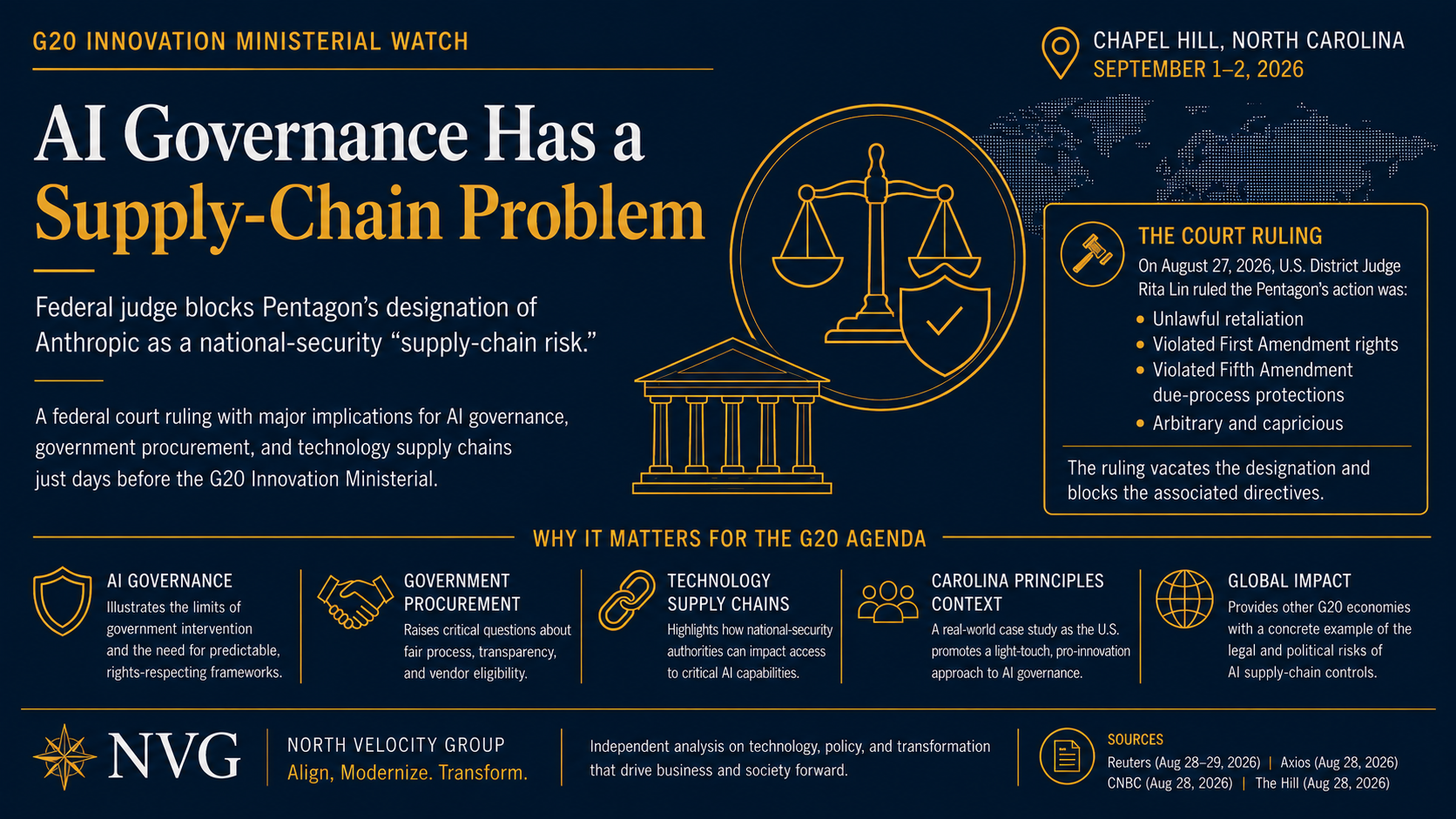
Just days before the G20 Innovation Ministerial convenes at the Carolina Inn in Chapel Hill, North Carolina, a federal judge struck down the Pentagon's designation of Anthropic as a national-security "supply-chain risk," ordering the label removed.
U.S. District Judge Rita Lin issued the 59-page ruling Thursday evening, August 27, finding that the Department of Defense, now also referred to in court filings as the Department of War, had engaged in unlawful retaliation against Anthropic in violation of the First Amendment, and had denied the company the pre-deprivation process required under the Fifth Amendment. She also found the designation arbitrary and capricious, writing that the record showed it stemmed from a "desire to make a public example" of the company.
In Plain English
Anthropic makes the Claude AI chatbot. The Pentagon wanted the military to be able to use Claude for anything, including fully autonomous weapons and surveillance of Americans. Anthropic said no to those two uses. In response, the Pentagon labeled Anthropic a "national security risk," a designation normally reserved for firms tied to hostile foreign governments, which effectively cut the company off from federal work. A federal judge just ruled that the Pentagon's label was illegal retaliation and ordered it lifted. The ruling lands just before a major international meeting on AI rules, so it's becoming a real-world test case for how far governments can go in policing the companies that build their technology.
That matters well beyond Anthropic.
The dispute traces back to March 2026, when Anthropic sued in the U.S. District Court for the Northern District of California after President Trump directed federal agencies to stop using Claude and Defense Secretary Pete Hegseth designated the company a supply-chain risk. That followed a breakdown in talks over two guardrails Anthropic refused to lift for military use of its models: fully autonomous lethal weapons and mass surveillance of Americans. It was the first time the designation, drawn from a procurement statute intended to protect military systems from foreign sabotage, had been applied publicly to a U.S. company.
The G20 Innovation Ministerial, co-hosted by the U.S. Department of Commerce and the White House Office of Science and Technology Policy, runs September 1 and 2 and is expected to focus heavily on AI governance and the U.S.-backed "Carolina Principles," a proposed non-binding framework emphasizing lighter-touch regulation and reliance on existing sector regulators rather than new AI-specific regulatory bodies. Commerce Secretary Howard Lutnick and OSTP Director Michael Kratsios are set to host fireside chats with OpenAI's Sam Altman and Nvidia's Jensen Huang, with Elon Musk and investor David Sacks also expected to take part.
Against that backdrop, the Anthropic case presents a very real test of the limits of government intervention in emerging technology.
The issue isn't whether governments should manage AI risk
They should.
The harder question is how.
Governments increasingly have legitimate concerns about AI safety, national security, privacy, cybersecurity, autonomous systems and the use of advanced models in sensitive environments.
But governments also depend on private companies to build the technology they increasingly want to deploy.
That creates a tension:
You cannot simultaneously demand rapid private-sector innovation and create unpredictable government intervention that makes companies uncertain whether disagreeing with a government agency could threaten their ability to compete for contracts.
The Anthropic ruling puts that tension into sharp relief.
The Pentagon argued that Anthropic's refusal to permit unrestricted military use of its models justified treating the company as a national-security risk. Anthropic argued the government's response was retaliation for a protected policy position, not a genuine security judgment, and pointed to the fact that the Pentagon kept pursuing other work with the company even after the designation.
Judge Lin sided with Anthropic's constitutional and administrative-law arguments.
That creates a powerful case study for the G20.
From AI regulation to AI supply-chain governance
The most interesting part of this story may not be the AI model itself.
It is the supply chain.
AI is becoming infrastructure.
The model provider, cloud platform, semiconductor manufacturer, data center, networking provider, energy supplier and government customer increasingly form one interconnected technology ecosystem.
That means governments will inevitably make decisions about which companies can participate in critical technology ecosystems.
But once governments begin making those decisions, questions of due process, transparency, procurement rules, national-security authority and regulatory consistency become business-critical issues.
This is where the Anthropic case becomes relevant to every multinational technology company, not just AI companies.
The G20 has an opportunity
The upcoming ministerial should not simply ask:
"How do we regulate AI?"
A better question is:
"How do we govern AI without undermining the technology ecosystem we need to build it?"
That requires more than choosing between "regulation" and "innovation."
It requires predictable rules.
It requires transparent government decision-making.
It requires clear procurement standards.
It requires defined national-security authorities.
And it requires mechanisms that allow governments to manage legitimate risks without creating arbitrary or politically unstable technology policies.
The Carolina Principles, according to people familiar with the discussions, would steer G20 members away from new AI-specific regulators and toward differentiated, sector-by-sector approaches, alongside joint public-private testing of emerging systems. If members reach consensus at the ministerial, the framework is expected to be forwarded to the G20 leaders' summit in Miami this December.
But the Anthropic ruling demonstrates why light-touch regulation still needs strong governance.
Less regulation does not mean less governance.
It means governance has to be more precise.
What we're watching at the G20
The September 1 to 2 ministerial now has a particularly important backdrop.
We'll be watching for four things:
1. AI governance: Does the G20 move toward common principles for AI regulation?
2. Government procurement: How will governments define acceptable AI vendors for sensitive applications?
3. Technology supply chains: How much authority should governments have to exclude companies from strategic technology ecosystems?
4. Predictability: Will the emerging international framework give technology companies clearer rules, or simply create another layer of uncertainty?
One more thing worth watching: this fight isn't fully over. The government is expected to appeal Thursday's ruling, and Anthropic is separately pursuing a related, still-pending challenge before the D.C. Circuit over a different statute the Pentagon has invoked. Thursday's decision resolves one front of the dispute, not the whole of it.
The Anthropic ruling is a reminder that AI governance is no longer an abstract policy debate.
It is becoming an operating-model issue.
For technology companies, investors and enterprise leaders, the question is increasingly not simply what AI can do.
It is who gets to decide where AI can operate, under what rules, and with what safeguards against arbitrary intervention.
That conversation is about to get much bigger.
Sources & Further Reading
- Axios, "Judge Blocks Pentagon Blacklist of Anthropic AI," August 28, 2026.
- Al Jazeera, "US Judge Blocks Pentagon Blacklisting of AI Firm Anthropic," August 28, 2026.
- CNN Business, "Judge Rules the Pentagon's Supply Chain Risk Label for Anthropic Unlawful," August 27, 2026.
- TechCrunch, "Anthropic Gets Its First Court Win Over the Pentagon's Supply-Chain Risk Label," August 28, 2026.
- The Hill, "Judge Rules Pentagon's Supply Chain Risk Designation for Anthropic Was Illegal," August 28, 2026.
- U.S. District Court for the Northern District of California, Anthropic PBC v. U.S. Department of War, et al., No. 3:26-cv-01996.
- U.S. Department of Commerce, International Trade Administration, "Media Advisory: Press Registration for the G20 Innovation Ministerial Is Open," August 2026.
- Axios, "Lutnick to Host Altman, Huang at G20 Innovation Ministerial in Chapel Hill," August 27, 2026.
Information current as of August 29, 2026. The government is expected to appeal the ruling, and a related case remains pending before the D.C. Circuit. The Carolina Principles remain under discussion and have not been finalized.
Disclosure: This article represents the analysis and perspective of North Velocity Group based on publicly available court filings, government sources, and news reporting. It reflects our interpretation of publicly available information and does not constitute legal, investment, or regulatory advice. North Velocity Group has no financial interest in Anthropic, the U.S. Department of Defense (Department of War), or any other party named in this article. The underlying litigation is ongoing, and developments, including a possible appeal, may change the matters discussed.