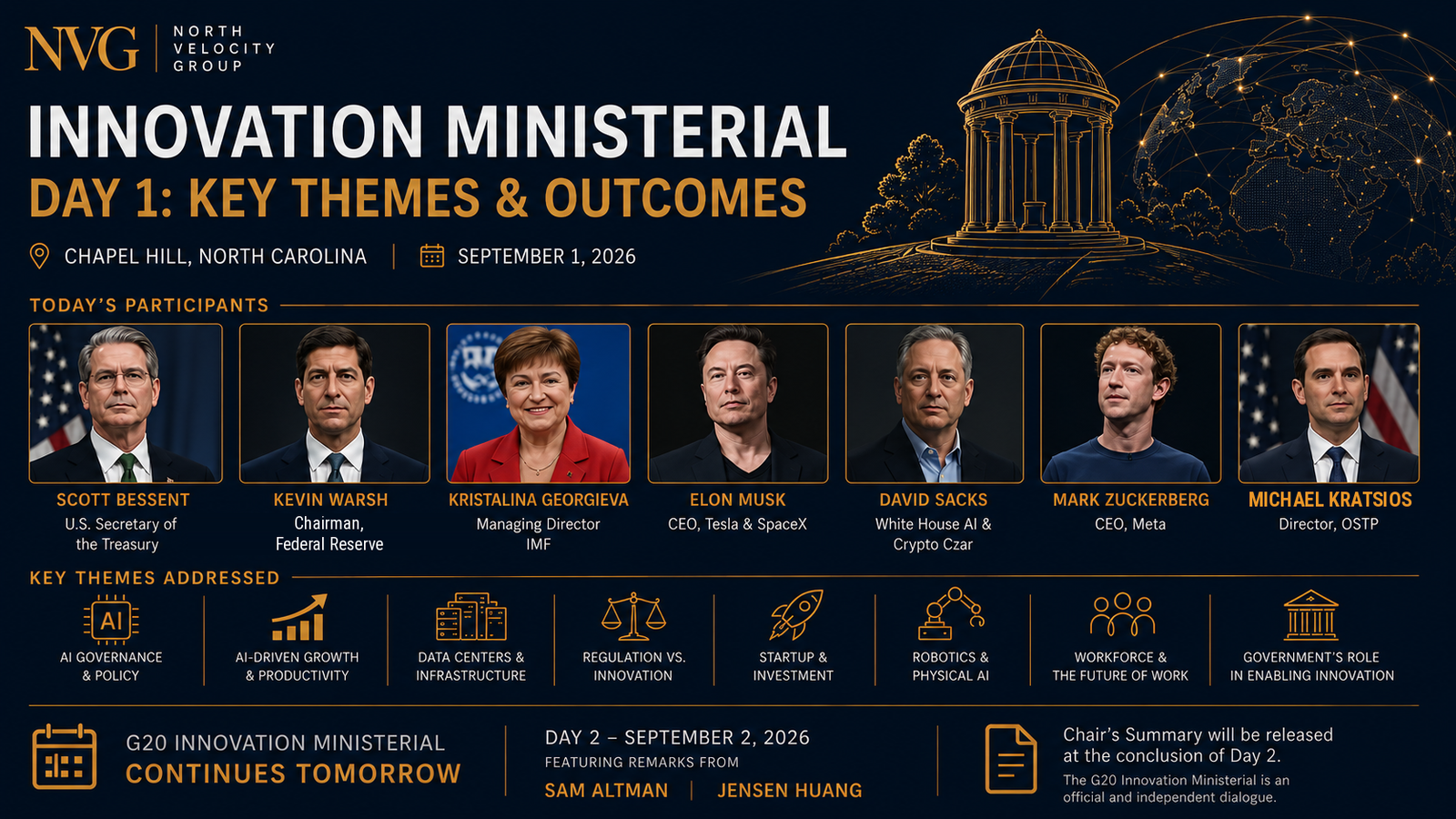
Two G20 meetings ran in North Carolina this week and closed a day apart. In Asheville, the finance ministers produced a statement that China would not fully sign. In Chapel Hill, the technology and trade ministers produced one that every member endorsed, China included. Same week, same state, opposite results.
In Plain English
The G20 is the group of the world's twenty biggest economies. Its ministers meet through the year, and those meetings normally end with a written statement everyone signs. The United States is running the G20 this year, which is why two of those meetings landed in North Carolina.
Asheville was about money. Finance ministers and central bankers met at the Omni Grove Park Inn to talk about trade, debt and the global economy. They published a statement, but China refused to sign four of its paragraphs: the one about keeping oil shipping lanes open, and three about trade surpluses, debt and who gets to referee those arguments. When the twenty countries that set the terms for trade and currency cannot agree in writing, anyone who buys, sells or borrows across borders is planning around an open question.
Chapel Hill was about technology. Trade and technology ministers met at the Carolina Inn, joined in person or by video by the people who run Nvidia, OpenAI, Meta, Palantir, Anthropic, Google DeepMind and Tesla. This one ended in full agreement. All twenty members signed a statement and a companion document called the Carolina Principles, named after the venue.
What the Carolina Principles actually say. The short version is: before writing a brand new law for a new technology, check whether the laws you already have cover it. If a rule is needed, write it narrowly for the genuinely new part. Give companies safe places to test things. Governments keep the right to do whatever they want at home. Nothing in it is binding, and nobody has to repeal anything. Europe's existing AI law stands.
Why this reaches ordinary life. AI runs in data centers, and data centers eat electricity. Speaker after speaker said there is not enough power, and not enough electricians and construction workers to build what companies have already promised. Where that power comes from, and who pays for it, is being settled town by town right now. If a data center plugs into the existing grid and competes with houses for the same supply, household bills tend to rise. If the operator builds or buys its own generation, they may not. That argument is live in North Carolina today. The jobs side is the mirror image: the same shortage that raises costs is also why apprenticeship and trades training turned up in a G20 document about artificial intelligence.
The rest of this is the detail, and what it means if you are planning technology investment.
What was actually agreed
Chapel Hill produced four documents rather than one, and they do different jobs. Reading them as a single announcement is the most common way to misread the week.
- The G20 Innovation Ministerial Statement, built on six pillars: pro-innovation policy frameworks, technology for opportunity and prosperity, skilled technical workforce development, intellectual property policies for AI, standards, and industrial innovation and supply chains.
- The Carolina Principles for Emerging Technologies, a three-part framework covering discovery and development, validation and commercialization, and adoption.
- The G20 AI Prosperity Objectives, nine workforce commitments covering AI credentials, apprenticeships, STEM integration and access to computing for research.
- The AI Prosperity Compact, which is not a government document at all. It is a one-page pledge with a blank signature line, designed for companies and universities to sign voluntarily.
Two details are worth correcting against the pre-meeting coverage. First, reporting ahead of the ministerial described the framework as asking members not to create new bodies to oversee AI. The published text does not say that. What it says is narrower: apply existing sector-specific regulatory frameworks where appropriate, and scope any new rules to address gaps that existing law cannot handle rather than duplicating protections already in force. Second, the principles explicitly disclaim harmonization. Members are not asked to align legal systems or standardize institutions, and the text reserves national sovereignty over technology governance.
That is a meaningfully smaller commitment than the early framing suggested, and it is also why twenty governments with incompatible regulatory philosophies could all sign it.
What happened in Chapel Hill
The Department of Commerce and the White House Office of Science and Technology Policy co-hosted the two-day ministerial at the Carolina Inn on September 1 and 2, led by Commerce Secretary Howard Lutnick and OSTP Director Michael Kratsios. Representatives of nineteen countries plus the European Union and the African Union attended, including China and the Russian Federation.
Consensus was not assumed going in. Reporting on day one centered on whether China would sign, and Kratsios told reporters on Tuesday afternoon that it had, before any text was public. By Wednesday that question was moot. Lutnick announced at the close that the group had "reached consensus on our G20 innovation ministerial statement," noting all twenty members were on board and that getting there had taken considerable work.
Day one belonged to the technology ministers, with industry appearing largely by video. Elon Musk criticized EU technology regulation and argued that innovation needs an environment where new things are legal by default. He warned that consensus expects a significant power shortfall next year, not in the distant future. Mark Zuckerberg said the buildout would require hundreds of thousands and possibly millions of skilled trade jobs, then noted that Meta itself cannot find the carpenters and electricians it needs for data centers it has already committed to. David Sacks argued that a thicket of laws already applies to AI. Google DeepMind's Demis Hassabis told ministers that human-level AI would carry ten times the impact of the Industrial Revolution. Kratsios also hosted Commonwealth Fusion Systems CEO Bob Mumgaard and Arizona State University President Michael Crow.
Day two moved to trade and commerce ministers, and Lutnick took the industry conversations in person. Nvidia's Jensen Huang argued that AI should be treated as national infrastructure in the same category as water, roads, electricity and the internet, and that every country needs enough of it to support its own economy. He urged policymakers to regulate demonstrated harms rather than hypothetical ones. Anthropic co-founder Tom Brown described the current industrial buildout as larger than the railroad expansion of the 1800s. Palantir CEO Alex Karp said he is not opposed to regulating AI but argued that guardrails have to be written by people who understand the technology well enough to see the downstream effects. Sam Altman compared refusing AI to refusing electricity a century ago, and told ministers that countries will regulate differently but that "it is non-negotiable that you have to use it."
Outside the Carolina Inn, students protested through the week and questioned who should be shaping AI policy. The town warned residents to expect heavy law enforcement presence. That is the same constraint the speakers inside were describing, expressed politically rather than technically.
What happened in Asheville
The finance track met at the Omni Grove Park Inn on August 31 and September 1, chaired by Treasury Secretary Scott Bessent alongside Federal Reserve Chairman Kevin Warsh. It closed with a chair's statement rather than a full communique, and the footnote is the story: the statement was agreed by all members present except China, which objected to paragraphs 4, 10, 11 and 13.
Those four paragraphs are not procedural. Paragraph 4 covers disruption to energy trade and calls for free, safe and predictable navigation through the Strait of Hormuz. Paragraph 10 addresses excessive and persistent global imbalances and says countries with large external surpluses should remove distortions that push them into overreliance on exports. Paragraph 11 anchors surveillance of those imbalances in the IMF's mandate. Paragraph 13 concerns sovereign debt and extending lessons from the Common Framework to countries where a meaningful share of external debt is owed to G20 members.
Bessent framed the disagreement publicly in trade terms, telling reporters China was the sole dissenter from language on non-market economies and cheap exports. He also used the meeting to press counterparts on the U.S. sanctions campaign against Iran, arguing that Washington and Beijing share more common ground than difference on preventing an Iranian nuclear weapon and keeping the Strait of Hormuz open. The chair's statement itself notes the global economy has stayed resilient through multiple shocks while warning that continued disruption to energy trade threatens durable growth.
Set the diplomacy aside. IMF surveillance, external debt exposure, energy shipping lanes, and the definition of a distorting trade practice are the items that determine sovereign risk, currency exposure, insurance cost and landed cost for anyone operating across borders. All four are still open, and they will be open when the finance ministers reconvene in Bangkok on October 15 and again at the Leaders' Summit in Miami on December 14 and 15.
Hold the two results next to each other. In one room China would not put its name to paragraphs about trade imbalances and shipping lanes. In another, roughly two hundred and fifty miles away in the same week, it signed a framework shaping how twenty economies approach the most consequential technology of the decade. Governments can be immovable on what costs them money this quarter and accommodating on what constrains them in five years.
What it means for planning
The temptation is to read a unanimous, light-touch declaration as relief. It is closer to the opposite.
Consensus is not convergence
Twenty governments agreed because the document was written to be agreeable. It explicitly preserves national sovereignty and explicitly does not require harmonized legal systems. A company deploying the same model in Brussels and in Texas still maintains two compliance postures for one product, and nothing signed this week narrows that gap. The practical move is unchanged: build governance to the strictest regime you actually operate under and treat looser ones as a subset of it. One control framework mapped across jurisdictions costs materially less than parallel frameworks maintained separately, and it is far easier to defend when a regulator or a customer asks how the system is controlled.
The intellectual property pillar is the sleeper
Pillar 4 of the ministerial statement is the one most likely to touch commercial contracts. It affirms the role of copyright in protecting creative work, acknowledges that the interaction between copyright and AI raises unresolved questions across jurisdictions, and leaves those questions to each member's own legal processes. That is a statement that the training data question stays unsettled and jurisdiction-specific. If your vendor contracts do not allocate indemnity for training data provenance and output infringement, this week gave you no cover and no timeline.
The sandbox language is usable now
The Carolina Principles commit members to regulatory sandboxes, experimental exemptions, streamlined permitting for pilots and demonstrations, and innovation-focused public procurement. For organizations in regulated sectors, that is the most immediately actionable content in the document. It creates a reasonable basis to ask a domestic regulator what supervised pilot pathways exist, and a reasonable expectation that the question will be entertained.
The binding constraint is power and people, not policy
The most aggressive AI builders in the world spent their time at a policy summit talking about megawatts and electricians, and workforce development earned its own pillar plus two dedicated documents. If your roadmap assumes capacity and skilled labor arrive on your timeline, that assumption deserves a hard test now. Interconnection queues, substation upgrades and trade labor availability are the schedule risk. Model selection is not.
A non-binding framework is not a rulebook
Nothing signed in Chapel Hill has legal force. A member that signs and then creates a new AI authority breaks nothing. Contract law, sectoral regulators, consumer protection and negligence claims continue to operate whether or not a dedicated AI regulator exists. Treat the framework as a signal about direction of travel, useful for anticipating where regulators are heading, and not as an input you can build a control framework against. Reading no new rules as no new exposure conflates two different things, and the gap between them tends to surface in a dispute rather than an audit.
Watch what the finance track could not agree on
Debt, imbalance and energy-security language failing at the ministerial level is a signal about sovereign, shipping and trade volatility that reaches procurement, hardware sourcing and capital planning well before it reaches the business pages.
Complexity is expensive; simplicity creates velocity
The week produced a genuine diplomatic achievement and very little that changes anyone's obligations. Four documents, twenty signatures, no enforcement, one dissent on the money, and a December summit in Miami that has to reconcile all of it. The organizations that come out of this well will be the ones that stop treating regulatory clarity as a prerequisite and start designing systems that hold up whichever way it goes.
The events, quotations and framework descriptions above are drawn from the primary documents and reporting listed below. The strategic interpretation and the recommendations are NVG analysis rather than established fact.
Sources & Further Reading
- U.S. Department of Commerce, "G20 Innovation Ministerial Statement," Pillars I to VI (primary document, PDF).
- U.S. Department of Commerce, "The Carolina Principles for Emerging Technologies" (primary document, PDF).
- U.S. Department of Commerce, "The G20 AI Prosperity Objectives" (primary document, PDF).
- U.S. Department of Commerce, "The AI Prosperity Compact" (primary document, PDF).
- U.S. Department of the Treasury, "G20 Chair's Statement," Second Meeting of G20 Finance Ministers and Central Bank Governors, Asheville, September 1, 2026. Includes the footnote recording China's objection to paragraphs 4, 10, 11 and 13.
- U.S. Department of the Treasury, "Secretary Bessent Announces 2026 G20 Finance Track Agenda and Finance Ministers and Central Bank Governors Meeting in Asheville, North Carolina." Confirms the Bangkok and Miami dates.
- The White House, "G20 Innovation Ministers Reach Consensus Statement," republished via Mirage News, September 2, 2026. Lists ministerial deliverables, fireside chat participants and attending delegations.
- Press Trust of India via Social News XYZ, "G20 seals pact on new emerging technologies principles," September 2, 2026.
- ABC11 / WTVD, "Policymakers, tech leaders discuss AI growth, workforce needs at G20 event in Chapel Hill." Day two remarks from Lutnick, Altman, Huang and Brown.
- ABC11 / WTVD, "G20 Innovation Ministerial talks spotlight AI, data centers as Musk, Zuckerberg weigh in virtually." Day one remarks and the power shortfall warning.
- CNBC, "China dissented from G20 statement opposing 'cheap exports' flooding market, Bessent says," September 1, 2026.
- CNBC, "G20 Innovation Ministerial: AI policy live updates," September 2, 2026. Day two remarks from Huang, Karp and Altman.
- Carolina Journal, "Bessent ends G20 Asheville meeting with Iran message," September 1, 2026.
- The Hill, "Trump admin rallies G20 support for Iran: Five takeaways," September 2, 2026.
- The Daily Tar Heel, "G20 Innovation Ministerial kicks off in Chapel Hill with AI, emerging technology as centerpieces of discussion."
- Axios, "Lutnick's G20 summit flex: Parade of tech moguls in N.C. today," September 2, 2026.
- Town of Chapel Hill, "High-Profile Event Downtown September 1 & 2."
Information current as of the evening of September 2, 2026. Both the G20 Finance Ministerial in Asheville and the G20 Innovation Ministerial in Chapel Hill have concluded, and the four Chapel Hill outcome documents are published. An earlier version of this article, written while the Innovation Ministerial was still in session, described China's endorsement as reported rather than confirmed and cited pre-meeting reporting that the framework would ask members not to create new AI oversight bodies. Both points have been corrected against the published texts. The finance track reconvenes in Bangkok on October 15, and the Leaders' Summit is scheduled for December 14 and 15 in Miami.
Disclosure: This article is published by North Velocity Group LLC (NVG) for informational and analytical purposes. It reflects NVG's interpretation of publicly available information and does not constitute legal, investment, regulatory or other professional advice. NVG has no affiliation with the G20, the U.S. government, or any organization named in this article, and no financial interest in any company discussed.