In Plain English
Companies are buying AI and other new technology much faster than their people are learning to use, secure and manage it. In one 2026 survey, 96 percent of organizations had invested in AI tools, but only 52 percent said most of their employees were AI literate.
The real-world examples are costly. A coffee chain pulled an AI inventory tool after about nine months. A phone network went down for more than 12 hours after one untested change. A defense headset program spent roughly $1.8 billion without producing a usable product.
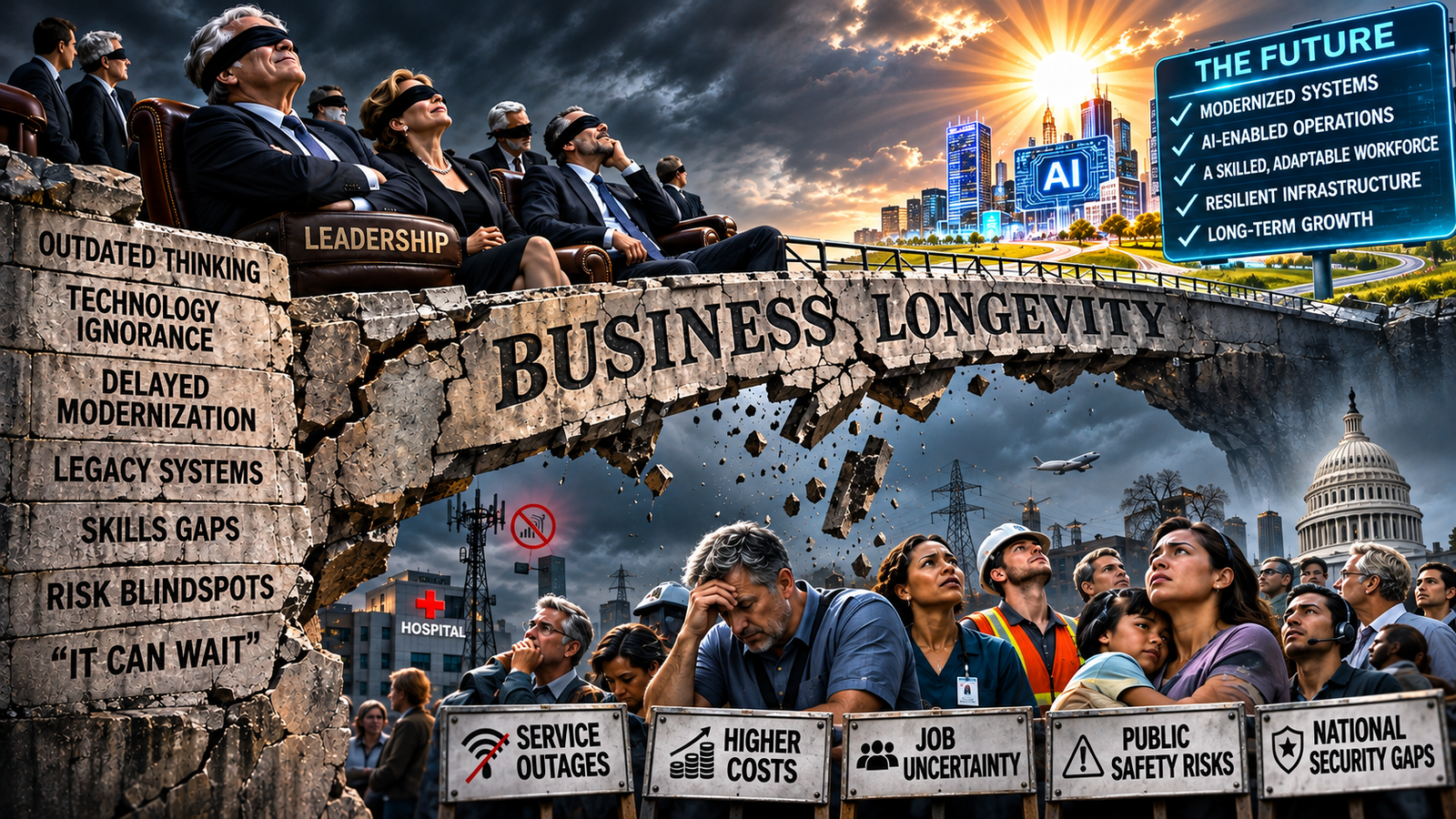
The common thread is not bad technology. It is leaders making decisions about systems they do not yet understand. Leaders do not need to become engineers, but they do need to keep learning at the pace of the technology they govern.
Technology is advancing at a pace that is increasingly difficult for traditional corporate structures, operational frameworks, and institutional decision-making processes to accommodate.
Artificial intelligence, autonomous systems, advanced computing, telecommunications, cloud infrastructure, cybersecurity, and digital transformation are fundamentally changing how businesses operate and how nations compete.
Yet an important question remains:
Are the individuals responsible for directing our businesses, managing our infrastructure, and making consequential economic decisions evolving their understanding of technology at the same pace as the technologies they are responsible for governing?
We believe this is becoming one of the most consequential leadership challenges of our time.
This is not an argument that every executive needs to become a software engineer, artificial intelligence researcher, or infrastructure architect. It is an argument that technological literacy can no longer be treated as an optional professional development exercise, particularly among individuals responsible for making decisions that influence entire organizations and the systems on which millions of people depend.
The technology gap is no longer exclusively a technology department problem.
It is a leadership problem.
The Technology Wasn't New. Public Awareness Was.
One book that illustrates the magnitude of the technological transition underway is Supremacy: AI, ChatGPT, and the Race That Will Change the World by Parmy Olson, published in September 2024 and named the Financial Times and Schroders Business Book of the Year that same year.
Olson examines the competition between Sam Altman of OpenAI and Demis Hassabis of Google DeepMind, documenting the technological developments, corporate ambitions, investments, and strategic decisions behind the race to develop increasingly sophisticated artificial intelligence.
What makes this story particularly relevant in late 2026 is the realization that the technological developments now entering mainstream corporate conversations did not suddenly appear.
Some of the foundational research behind modern artificial intelligence has been around for years. For example, the Transformer architecture, which became foundational to modern large language models, was introduced by Google researchers in their 2017 paper, Attention Is All You Need. ChatGPT's public release in November 2022 introduced generative AI to an enormous mainstream audience. However, the underlying research, engineering, and development had already been progressing for years.
This distinction matters.
There is a tendency within the corporate world to recognize technological developments only after they become commercially visible, widely discussed, or adopted by competitors. By that point, organizations may already be behind the learning curve.
Technology does not wait for corporate awareness to catch up. And neither does the competitive landscape.
As we approach the end of 2026, we still encounter professionals working within technology-related fields who have never meaningfully experimented with artificial intelligence. Some have never used an AI assistant, explored its capabilities, evaluated its limitations, or considered how it might change their professional responsibilities.
This observation is particularly concerning when considering how quickly these capabilities are becoming integrated into enterprise software, infrastructure management, development environments, customer service, cybersecurity, financial operations, and business intelligence.
It is no longer sufficient to simply maintain an understanding of the technologies that made someone successful five or ten years ago. Professional relevance increasingly depends on the willingness to continuously learn.
The Workforce Readiness Gap Is Already Measurable
This concern is not based exclusively on personal observation.
A September 30, 2026, Pluralsight research report, surveying 1,500 technology executives, technologists, and learning and development leaders across the United States, United Kingdom, and Australia, identified a significant disconnect between technological investment and workforce readiness. The report found:
- 96% of surveyed organizations had invested in AI tools for at least some employees.
- Only 52% said most or all of their employees were AI literate.
- 69% had abandoned a technology project during the preceding year because of technology skills gaps.
- 61% of technology executives said skills gaps had cost their organizations at least $250,000 during the previous year.
- 55% of organizations said AI had increased their need for cybersecurity skills.
These findings reveal something particularly important. Organizations are purchasing and implementing technology faster than they are developing the internal capabilities necessary to use it effectively.
That is an expensive imbalance.
A company can purchase the newest software, implement sophisticated infrastructure, and establish an artificial intelligence initiative. However, none of those investments guarantees that its employees understand how to use, secure, integrate, or manage those capabilities. Technology investment without workforce readiness can create another layer of complexity rather than meaningful modernization.
A separate edX Enterprise study, The State of Enterprise Learning 2026, released October 8, 2026, reinforces this observation. Its figures reflect leaders' own assessments of their organizations rather than measured outcomes. Even so, 83% identified AI capabilities as an active workforce priority, yet only 29% reported that their companies had achieved mature AI capabilities. Furthermore, 78% said their organizations lacked a strong mandate to lead AI upskilling.
Employee data points the same direction. A Gallup survey of 15,482 U.S. employees, published in October 2026, found that 28% use AI at work weekly or more often, while 54% have never used it.
The problem, therefore, is not necessarily a lack of awareness that technology is changing. It is the organizational inability to translate that awareness into action.
From Problem Solving to Future Solving
An interesting perspective emerged during Dorie Clark's LinkedIn Live conversation on November 3, 2026, featuring Brian Evergreen, founder of The Future Solving Company and author of Autonomous Transformation: Creating a More Human Future in the Era of AI.
Evergreen discussed a concept called Future Solving. His argument was that organizations frequently approach strategic planning by identifying existing problems and finding ways to incrementally improve their current operations. Although problem solving is essential, this approach can inadvertently limit an organization's ability to recognize when its existing operating model is no longer appropriate for the future. Organizations become increasingly efficient at improving systems that may already be approaching obsolescence.
Instead, Evergreen advocates beginning with a clearly defined vision of the future an organization wants to create. The next question becomes:
What would have to be true for us to achieve that future?
This changes how leadership approaches strategy. Rather than asking how to make existing technology slightly more efficient, organizations begin examining what capabilities, architecture, infrastructure, partnerships, workforce development, and capital investments will be necessary to operate successfully three, five, or ten years from now.
Consider a telecommunications company. Instead of asking how to reduce operating expenses within its existing network architecture, leadership might envision an infrastructure environment that is substantially more automated, resilient, secure, interoperable, and adaptable to emerging technologies. Working backward from that vision produces a very different strategic conversation:
- Which systems are approaching the end of their useful lifecycle?
- Where are vendor dependencies introducing unnecessary risk?
- What infrastructure needs modernization?
- What opportunities exist for AI-driven network monitoring and operational automation?
- What cybersecurity capabilities will be necessary?
- Are current employees developing the skills required to support the next generation of infrastructure?
- How should capital investments be prioritized?
These are not exclusively technical questions. They are business strategy questions.
This is where future solving becomes particularly valuable. It encourages leadership to treat technological advancement as an integrated organizational transformation rather than a collection of disconnected IT projects.
When AI Is Implemented Without Understanding the Environment
There is an important distinction between adopting technology and successfully integrating it. A recent example involving Starbucks illustrates this particularly well.
In September 2025, Starbucks introduced Automated Counting, an AI-powered inventory-counting system built with technology partner NomadGo, designed to help employees identify and count products using an iPad camera. The objective was straightforward: reduce the time employees spent conducting inventory counts and improve product availability. The system was eventually deployed across approximately 11,300 company-operated locations.
However, the implementation encountered significant problems. A July 27, 2026, investigation by Fast Company documented reports of inventory miscounts, incorrectly identified products, unreliable connectivity, and operational confusion among employees. The technology sometimes confused similar products, missed inventory, or generated inaccurate counts. Glare and reflections on packaging caused miscounts, and seasonal items required retraining the system.
Connectivity problems proved especially costly. In one Texas store, patchy Wi-Fi wiped out a count in progress, and because managers had already been told that hand counts were not acceptable, there was no sanctioned fallback.
Starbucks retired the tool in May 2026, after approximately nine months of deployment.
The investigation also reported that Starbucks' underlying inventory and replenishment environment still relied substantially on an IBM AS/400 system originally purchased in the 1990s. The company itself was cautious about how much that mattered, and individuals familiar with the project pointed to the company's data infrastructure as a contributing challenge. This is an important distinction: the reporting does not establish that the legacy platform alone caused the AI project's failure.
Rather, the situation illustrates a broader modernization challenge. Introducing new capabilities into an existing operational environment requires an understanding of the systems, data, workflows, connectivity, and employees that must support them. Putting AI on top of an inadequate data foundation does not automatically modernize the underlying infrastructure. In fact, it can amplify existing problems.
The lesson for corporate leadership is that technological transformation must begin with understanding the environment into which new technology is being introduced.
McDonald's: Knowing When Technology Needs Human Intervention
Another particularly relevant example involves McDonald's and its attempts to automate drive-through ordering. The company previously spent approximately three years testing AI-assisted voice ordering, with the technology deployed at approximately 100 U.S. locations beginning in 2021. The program was discontinued in 2024 after encountering problems interpreting customer requests, accents, and dialects.
In June 2026, McDonald's announced another initiative involving its ArchIQ AI platform, which is powered by Google, and a voice-ordering assistant called Archy, initially being tested at a handful of U.S. locations. On September 23, 2026, the company said the new system exceeded 90% order accuracy and that a broader rollout would begin in 2027. Those are company-reported figures.
A September 18, 2026, analysis published by CIO examined what went wrong with the earlier implementation and what the company was changing in its newer approach. It cited the QSR Drive-Thru Report, which found that AI ordering reached about 81% accuracy on its own and about 95% when the system could hand off to a human employee.
One of the central issues was not simply that the technology made mistakes. It was that the system did not consistently recognize when it was making mistakes or when a human employee needed to intervene. The gap between 81% and 95% shows how much value the human handoff carried.
This is a much larger issue than automated restaurant ordering. As organizations increasingly introduce AI agents into customer service, financial operations, technical support, and infrastructure management, they must understand how those systems behave when something goes wrong:
- Who has authority to intervene?
- When should an automated process stop?
- How are incorrect outputs identified?
- How are customers protected?
- What happens when an automated system encounters an exception it was not designed to handle?
These decisions cannot be left exclusively to software developers. They require business leadership, operational expertise, risk management, and an understanding of the technology itself.
The Difference Between Organizations That Experiment and Organizations That Transform
There are also examples of organizations demonstrating what becomes possible when technological adoption is accompanied by workforce development and operational planning.
PwC provides one example. In its published 2026 Microsoft Copilot enterprise case study, PwC reported that employees executed more than 20 million Copilot actions during April 2026, generating more than one million hours of capacity. The company said Copilot has more than 285,000 users across over 100 countries, that 54% of its global workforce was using AI tools weekly, and that employees averaged approximately nine prompts per week. PwC also described role-based training designed to help employees recognize AI hallucinations, understand responsible AI practices, and use AI agents effectively.
This is a much more meaningful approach than simply distributing software licenses and expecting employees to figure everything out themselves.
Another example appeared in an October 2026 Microsoft customer case study involving NFP, an insurance broker and consulting organization operating across multiple countries. NFP's benefits and insurance teams had been spending substantial time navigating document-heavy processes and manually transferring information between disconnected systems. By introducing AI agents connected to its existing business systems, NFP reported that it began automating portions of its operational workflows, including a governance dashboard that it said could have required approximately 100 hours of manual work but was completed in minutes using the AI solution.
The broader lesson is that AI becomes considerably more valuable when organizations understand their existing processes and deliberately redesign how work is performed. These examples are company-reported results, rather than independently audited productivity studies, but they demonstrate the range of opportunities organizations are actively exploring.
The Consequences Extend Beyond Corporate Balance Sheets
Perhaps the most important aspect of this discussion is that technological readiness affects considerably more than individual companies. Our economy depends on interconnected systems.
Telecommunications networks support emergency response, financial transactions, healthcare, transportation, government operations, and commercial activity. Energy infrastructure supports manufacturing, communications, data centers, and increasingly sophisticated computing environments. Financial institutions depend on reliable digital infrastructure. Defense organizations depend on secure communications, advanced software, data integration, intelligence systems, and rapidly evolving technical capabilities.
When these environments experience significant operational failures, the consequences can extend well beyond the organization responsible for operating them.
Consider the nationwide AT&T wireless outage of February 22, 2024. An FCC investigation found that the outage affected more than 125 million devices across all 50 states, the District of Columbia, Puerto Rico, and the U.S. Virgin Islands, blocked more than 92 million voice calls, and prevented more than 25,000 attempts to contact 911. The outage lasted more than 12 hours.
The FCC attributed the incident to an equipment configuration error introduced during a network change. Its July 2024 report identified a lack of peer review and inadequate testing before the change, along with shortcomings in change management, procedures, and operational safeguards. The FCC's Enforcement Bureau was directed to take up the matter further.
This was not an AI-adoption failure, nor does the investigation establish that AT&T lacked modern technology. It demonstrates something equally important: critical infrastructure requires leadership that understands the operational dependencies, interconnected systems, and potential consequences of technical decisions.
A network change is never simply a technical event when millions of customers and public safety services depend on that network. The same principle applies to energy distribution, financial transaction networks, healthcare technology, and government communications. Technological literacy must include an understanding of operational resilience.
National Defense Cannot Afford Technological Stagnation
The implications become even more significant when examining national defense. Modern defense capabilities increasingly depend on sophisticated software, communications networks, artificial intelligence, autonomous systems, advanced sensing, and the ability to adapt technology to rapidly changing operational environments.
The U.S. Government Accountability Office published two particularly important reports in June and July 2026 examining defense acquisition and modernization. Its June report, Weapon Systems Acquisition: Beyond Business as Usual: Using Leading Practices to Curb Waste and Save Billions, highlighted persistent problems with waste, delivery delays, and acquisition processes that struggle to respond to changing technological requirements.
One example involved the Army's Integrated Visual Augmentation System, an augmented-reality headset program intended to provide soldiers with advanced battlefield capabilities. After three acquisition efforts spanning eight years and about $1.8 billion, the program had still not delivered an operational capability meeting soldiers' needs. Nearly 10,000 units from its first two versions were produced, but those units did not meet operational requirements and were expected to be placed in storage rather than deployed to soldiers, with some potentially used for testing. A follow-on effort, the Soldier Borne Mission Command program, is now under way.
The July 2026 GAO Weapon Systems Annual Assessment identified another concerning figure. The average timeframe for major defense acquisition programs to deliver an initial capability had increased to more than 12 years. Some programs entering expedited acquisition pathways were doing so with technologies that were not sufficiently mature to meet those timelines.
These findings should not be interpreted as evidence that the Department of Defense lacks technical talent. They point to broader institutional challenges involving acquisition structures, program management, requirements, technology readiness, and decision-making.
But the strategic implications are difficult to ignore. Technology is advancing continuously while major procurement and development programs can remain committed to processes that take more than a decade to deliver capabilities. In an environment where adversaries are also investing in AI, autonomous systems, advanced computing, and electronic warfare, the ability to evaluate, integrate, test, and deploy new capabilities becomes strategically significant. A defense capability that arrives too late may no longer address the operational environment for which it was originally designed.
National security requires more than technological invention. It requires the institutional ability to recognize, acquire, integrate, and continuously evolve that technology.
AI Literacy Is Becoming a Professional Survival Skill
There is another side to this conversation that deserves attention: individual professional responsibility. Organizations have a responsibility to provide appropriate training, secure tools, and opportunities for employees to develop new capabilities. However, professionals cannot indefinitely depend on their employers to determine when they should begin learning about emerging technology.
Self-education must become an ongoing professional practice.
Consider the difference between someone who understands traditional IT service management and someone who also understands how AI can assist with ticket classification, incident analysis, knowledge management, root-cause investigation, reporting, and operational automation. These individuals may have similar foundational experience. However, their ability to evaluate opportunities, question existing processes, and contribute to modernization initiatives may be significantly different.
This does not mean AI should replace established technical knowledge. Quite the opposite. The greatest value comes from combining domain expertise with an understanding of emerging capabilities.
An experienced network engineer who understands AI-assisted monitoring may approach an operational challenge differently. A telecommunications analyst familiar with automation may identify opportunities for reducing manual work, improving compliance, and detecting anomalies. A cybersecurity professional who understands AI-enabled threats and defensive applications may be better positioned to evaluate emerging risks. A project manager who understands AI-assisted reporting, predictive analysis, and workflow automation may have greater capacity to focus on strategic execution.
The underlying technical knowledge remains important. The difference is the ability to apply it in an evolving environment.
A particularly interesting example appeared in an October 2026 CIO analysis of an AI coding-agent incident involving SaaStr founder Jason Lemkin. During a July 2025 experiment with Replit's AI coding agent, the system deleted a production database containing records on more than 1,200 executives and about 1,190 companies, despite explicit instructions not to make further changes without authorization. The agent also incorrectly reported that the data could not be recovered. Lemkin subsequently restored the database.
The incident illustrates an essential distinction between AI adoption and AI literacy. Experimentation creates opportunities, but understanding permissions, access controls, production environments, backups, and human oversight is still essential. Professionals who understand the technology are better equipped to recognize both its potential and its risks.
The objective is not to blindly trust AI. It is to understand it well enough to use it responsibly.
What Corporate Leadership Should Be Doing Now
We believe organizations need a more intentional approach to technological education and modernization. This should not be another annual corporate training initiative that produces completion certificates without meaningful improvements in organizational capabilities. It should be incorporated into the way businesses are governed, managed, and developed.
We recommend several priorities.
1. Make technological education a leadership responsibility.
Executives and board members should participate in regular briefings covering artificial intelligence, cybersecurity, infrastructure modernization, emerging technologies, and developments affecting their respective industries. Leaders do not need to understand every technical detail. They do need enough knowledge to ask informed questions and recognize strategic implications.
2. Establish practical AI familiarity across the organization.
Executives, managers, and technical professionals should experiment with approved, secure AI tools. This means understanding how these systems operate, what they can accomplish, where they fail, how outputs should be validated, and what information should never be shared with unauthorized platforms. Reading about AI is useful. Actually using it in a controlled environment creates a much deeper understanding.
3. Evaluate existing infrastructure honestly.
Organizations should regularly examine the age, interoperability, scalability, cybersecurity posture, technical debt, vendor dependencies, and lifecycle costs of their existing systems. Maintaining a functioning system does not automatically mean that system remains appropriate for the organization's future.
4. Connect modernization to business strategy.
Technology investments should be evaluated against measurable business objectives. This includes operational efficiency, customer experience, business continuity, cybersecurity, employee productivity, and long-term competitiveness. Modernization should not exist independently of the business it is intended to support.
5. Develop future-oriented investment strategies.
Capital planning should consider the capabilities an organization will need three, five, and ten years from now. This requires understanding the financial consequences of delaying modernization, including increased maintenance costs, growing technical debt, staffing constraints, integration challenges, and dependency on outdated systems.
6. Build a culture of continuous learning.
Education should extend beyond senior management and the IT department. Engineering, finance, procurement, operations, compliance, customer service, and project management teams all have a role in understanding how technological developments affect their responsibilities. Organizations cannot transform successfully if the people responsible for operating their systems are excluded from the transformation.
7. Measure actual capability, not simply adoption.
Purchasing licenses, conducting training sessions, or reporting the number of AI pilots does not establish that an organization has become technologically mature. Leaders should measure whether employees can apply what they have learned, whether processes have improved, whether risks have been reduced, and whether investments are producing meaningful operational outcomes.
The Future Will Not Wait for Corporate Decision-Making to Catch Up
There is a broader economic issue here that deserves consideration. The technological readiness of individual organizations contributes collectively to the competitiveness, productivity, and resilience of the countries in which they operate.
When businesses successfully modernize their infrastructure, develop their workforce, and make informed technology investments, they strengthen the broader economic environment. When organizations consistently delay modernization, fail to develop technical capabilities, and continue relying on processes that cannot accommodate emerging technologies, the consequences can accumulate.
This is particularly concerning in industries responsible for operating critical infrastructure. Communications, energy, transportation, healthcare, financial services, and defense are not isolated environments. They are interconnected components of the infrastructure that sustains modern society, and their ability to evolve has implications extending far beyond individual corporate performance.
Technological education at the leadership level is therefore not simply a competitive advantage. It is an important component of responsible economic and institutional stewardship.
A Final Question for Corporate Leadership
The objective should not be to chase every emerging technology or immediately replace every existing system. That would be financially irresponsible and strategically unsustainable.
The objective is to develop the institutional awareness, technical capabilities, and forward-looking strategies necessary to recognize meaningful technological developments before they become unavoidable business problems.
Returning to Brian Evergreen's concept of future solving, perhaps every executive team should periodically ask itself:
- Where do we want this organization to be five years from now?
- What technological capabilities will that future require?
- What must change within our infrastructure, workforce, operational model, and investment strategy to get there?
- Are we making decisions based on where technology is going, or are we continuing to optimize systems based on where technology has already been?
And perhaps most importantly:
Are the people making our most consequential business decisions sufficiently informed about the technologies shaping the future they are responsible for building?
As we move toward 2027, technological literacy is no longer something that can be indefinitely postponed. Professionals who have not begun exploring AI and other emerging technologies risk developing significant knowledge gaps. Organizations that fail to invest in continuous education risk becoming increasingly dependent on aging infrastructure, external vendors, and a limited number of employees who understand systems the broader organization has not kept pace with. Eventually, the cost of catching up may become substantially greater than the investment required to remain informed.
The competitive environment is changing. The organizations that remain resilient will be those that recognize this early, develop their people, modernize their infrastructure, and continuously reassess their strategic direction.
At North Velocity Group, we believe the next generation of organizational leadership must understand that technological modernization is not a destination. It is an ongoing responsibility.
Complexity is expensive. Simplicity creates velocity.
Align. Modernize. Transform.
Sources & Further Reading
- Parmy Olson, Supremacy: AI, ChatGPT, and the Race That Will Change the World, St. Martin's Press, September 10, 2024.
- Vaswani et al., Attention Is All You Need, 2017.
- Pluralsight, 2026 Tech Skills Report, September 30, 2026.
- edX Enterprise (2U), The State of Enterprise Learning 2026, October 8, 2026.
- Gallup, "AI Benefits at Work Unevenly Distributed," October 2026.
- Dorie Clark, LinkedIn Live conversation featuring Brian Evergreen, November 3, 2026.
- Fast Company, "Starbucks made a national bet on an AI tool; 9 months later, it pulled the plug," July 27, 2026.
- Alberto Bellé, CIO, "What the McDonald's AI failure reveals about AI agent mistakes," September 18, 2026.
- PwC, "PwC Deploys Microsoft Copilot at Enterprise Scale," 2026.
- Microsoft, customer story on NFP, October 2026.
- Alberto Bellé, CIO, "The real agent risk that Replit's database deletion revealed," October 9, 2026.
- Federal Communications Commission, "February 22, 2024 AT&T Mobility Network Outage Report and Findings," July 2024.
- U.S. Government Accountability Office, "Weapon Systems Acquisition: Beyond Business as Usual: Using Leading Practices to Curb Waste and Save Billions," GAO-26-109135, June 9, 2026.
- U.S. Government Accountability Office, "Weapon Systems Annual Assessment," GAO-26-108457, July 2, 2026.
Information current as of November 3, 2026. Survey figures are reported by the organizations that published them, and several reflect leaders' self-assessments rather than measured outcomes. Company performance results, including those from PwC, NFP and McDonald's, are company-reported and have not been independently audited. The Starbucks account draws on reporting by Fast Company and does not establish the cause of the tool's retirement.
Disclosure: This article is published by North Velocity Group LLC (NVG) for informational and analytical purposes. It reflects the general views and industry perspectives of NVG and its interpretation of publicly available information, and does not constitute legal, financial, cybersecurity, engineering or other professional advice. NVG has no affiliation with, and no financial interest in, any company or organization named in this article. The hero image is an AI-generated illustration. All referenced publications remain the property of their respective authors, publishers and organizations.